Imagining A Truly Global Austen
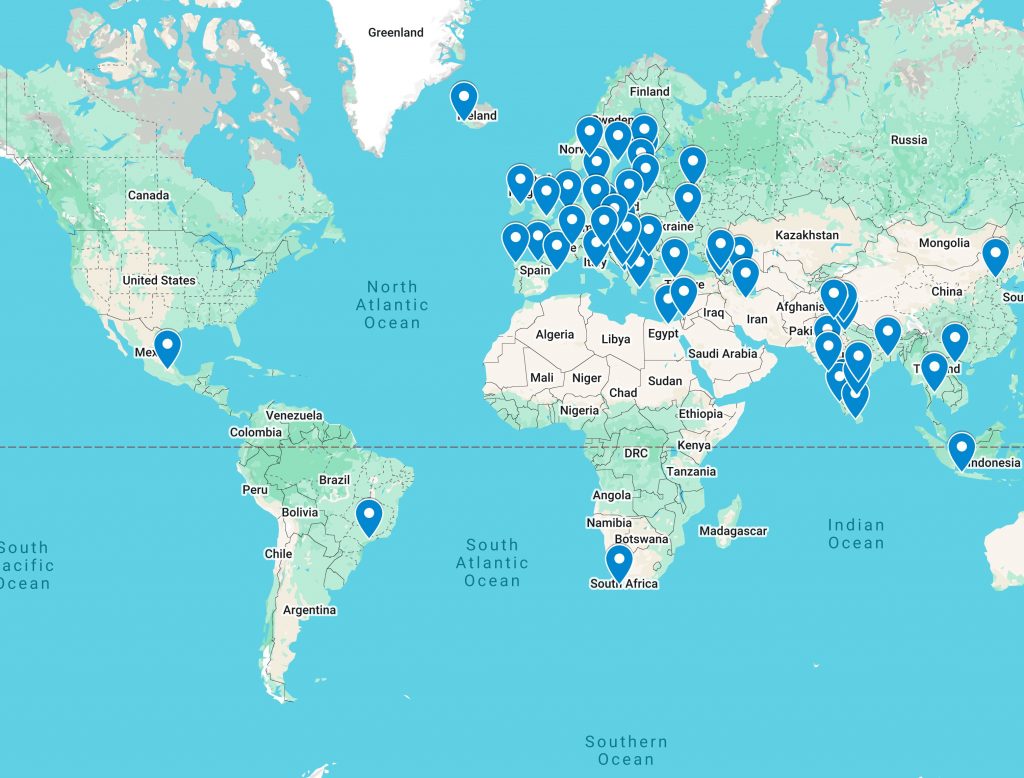
Austen has been read in at least 60 global languages, and this map lays them out for the first time. She appears across 4 continents, in 50 countries, speaking French, Spanish, and Italian as well as Gujarati, Indonesian, and Cornish. Click the link below to view the full interactive map!
Click here to explore Austen editions in languages you might not expect…
Spotlight on India
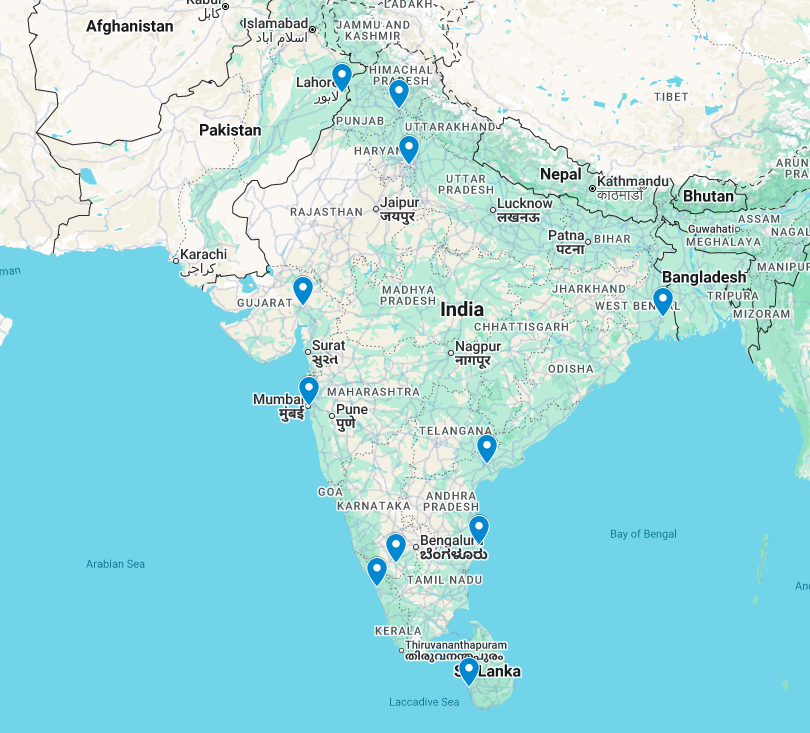
This map demonstrates the sheer range of translations recorded across India, in 9 different languages: Bengali, Gujarati, Hindi, Kannada, Malayalam, Marathi, Punjabi, Tamil, and Telugu. These were published all across the country, in Kolkata, Ahmedabad, New Delhi, Mysuru, Kozhikode, Mumbai, Chandigarh, Chennai, and Vijayawada respectively. (Also visible on the map is an Urdu translation, in Lahore, Pakistan, and a Sinhala translation in Colombo, Sri Lanka.) Translation data for India was difficult to uncover, and there are undoubtedly a great many more translations to be found and recorded in a greater diversity of languages: perhaps Sanskrit, Nepali, and Assamese.
My hope is that this map provides a starting point to provoke further discussion of Austen’s translation in India and across south and south-east Asia, a neglected area of study which poses fascinating questions about the impact of Empire on Austen’s legacy, and the capacity of translation to confound and complicate what Felix Mnthali refers to as ‘The Stranglehold of English Lit.’ in his 1961 poem of the same name.
About the Data
I have recorded the bibliographic information of one Austen edition for 60 distinct languages. 58 of these are translations of Pride and Prejudice, as there were only two countries where I could not find data for a Pride and Prejudice translation: Bosnia, where I instead recorded Katarina (Northanger Abbey), and Georgia, where I recorded Sense and Sensibility. These 60 languages show that Austen’s global reach is far greater than previously estimated (e.g., by Jane Austen’s House, which suggests 40), with the true total likely to be even higher still. Furthermore, these 60 translations were published across 50 countries, moving far beyond Europe to Mexico, Brazil, South Korea, Indonesia, South Africa, and so on. Surprisingly, there were two published close to home as well, both in 2015: a Latin translation published in England, and a Cornish translation published in Ireland. With Austen’s popular regard only growing stronger thanks to recent events such as her 250th birthday last year, it is clear that this is an ever-expanding field with much more work needed to accurately document those languages and cultures which have been critically neglected in translation and reception studies.
As I have only recorded one edition for each language, I have tried to demonstrate as broad a spread of countries as possible. For example, I recorded a Mexican edition for the Spanish language, a Brazilian edition for Portuguese, and a Montenegrin edition for Serbian. Two countries in particular stood out for their linguistic diversity: India, with 9 editions as described above, and Spain, with 3 editions (in Catalan, Basque, and Galician). This data is by no means meant to be comprehensive; instead, it offers a glimpse of Austen’s global legacy and a point at which to begin further inquiries.